The Canada Protocol
VersionControl - FINALfinal v6.7.3 THIS ONE I SWEAR TO GOD
Problem: Version control in text-based projects can be a nightmare. Almost anyone can edit a Word doc or some Powerpoint slides. Which means everyone does. Before the deadline, there is no cost associated with producing an additional draft, so it doesn’t matter if it takes seven versions or fifty-eight.
Additionally, aside from the deadline, there is no concrete endpoint. Numbers go to infinity. Plus one.
What if, instead of numbers, we use Canadian city names?
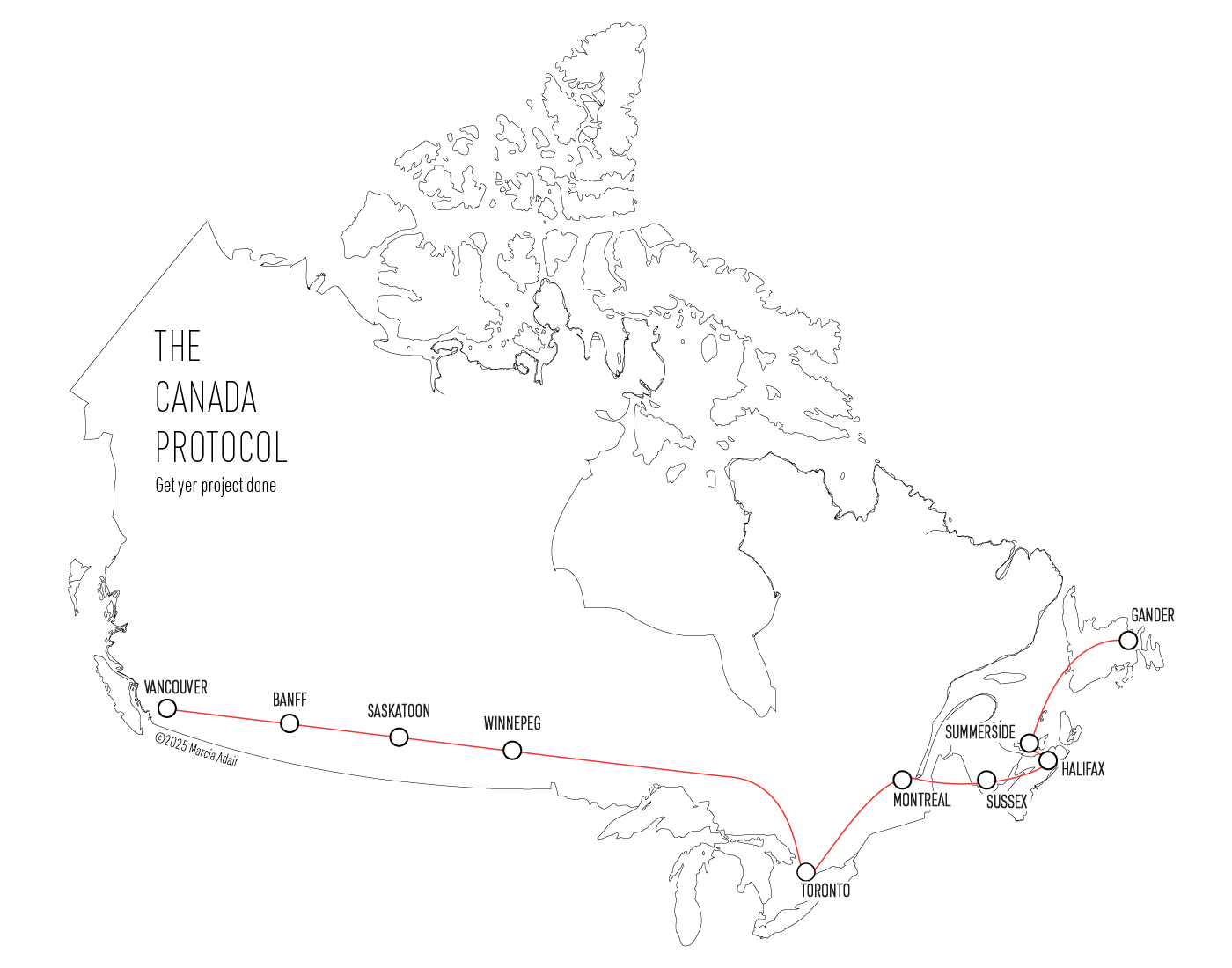
The Canada Protocol ©2025 Marcia Adair
Coincidentally, the distance between the cities mirros the natural rhythm of big projects. A strong start, some interesting problems to solve going over the mountains in Banff. Next is the Prairies between Banff and Winnipeg. The only way around is through. Boring but progress is relatively frictionless. This changes between Winnipeg and Toronto, the stretch where many projects die. The end seems an eternity away, motivation tanks and with it, momentum.
If the project leaves Toronto, it usually with a new impetus and a clearer sight of the end. Momentum returns. Production ramps up. Summerside is where you think the project is over and the hell of the last 15% becomes clear. One final slog, and you’re in Gander. Project complete and ready for a celebratory screech.
For the math nerds, if Halifax to Summerside is 1 two-week sprint unit, the whole path is 60 weeks.
Vancouver → Banff = 6 weeks
Banff → Saskatoon = 7 weeks
Saskatoon → Winnipeg = 8 weeks
Winnipeg → Toronto = 16 weeks
Toronto → Montreal = 5 weeks
Montreal → Sussex = 6 weeks
Sussex → Halifax = 2 weeks
Halifax → Summerside = 2 weeks
Summerside → Gander = 8 weeks
Use Case
I use The Canada Protocol when working on a project where loss of momentum is catastrophic. Book writing, for example, is exciting at the beginning and at the end. What comes between is a slog. In such a project, each new city represents a significant update in the draft, rather than small changes to a chapter or adding additional material.
The concept can easily be adapted for other projects, but works especially well for those with a long middle and an abstract horizon - an ERP migration, a significant product update or even a store opening. Any project where the deadline is visible but the path there isn’t.
Why it works
Numbers are an open system. Geographical points are closed. After Gander it’s the Atlantic Ocean, which means unless you fancy a long, cold swim, the project has to be over by then
The map gives team members something concrete for discussions - we reach Halifax in three days, what do I have to finish by then? For multi-team projects, being able to see at a glance which city the other teams are in helps with orientation and momentum.
Curious?
If you don’t want your project abandoned at a truckstop somewhere outside Sioux St. Marie, let’s talk.